If AI Can’t Read It, AI Won’t Recommend It
München, October 15th 2026 – INNOVATION DAY 2026: Carina Müller, Mediaplus Group and Sophie von dem Bussche, hmmh
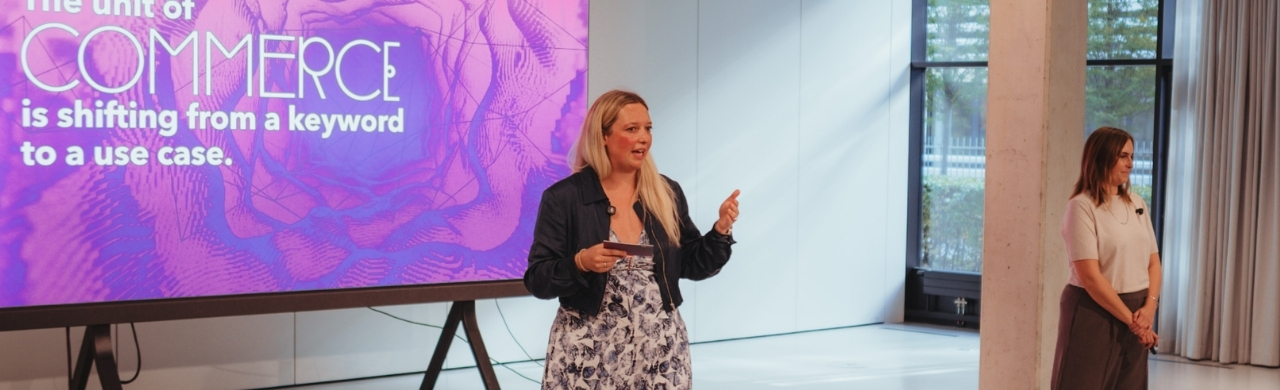
Agentic Commerce is having a moment. Across conferences, LinkedIn feeds and industry reports, the vision sounds compelling: autonomous agents comparing products, negotiating with brands and eventually completing purchases on our behalf. But at the Innovation Day 2026, Sophie von dem Bussche, Senior Business Development Manager at hmmh AG, and Carina Müller, General Manager Commerce at Mediaplus Group, argued that many companies are focusing on the wrong part of the story.
The real transformation of commerce is not happening sometime in the future. It is already happening today, as consumers increasingly use AI to discover, compare and evaluate products long before they make a purchase.
Commerce has reinvented itself many times before. Stores gave way to supermarkets. Catalogs moved online. E-commerce evolved into omnichannel experiences. Social platforms blurred the line between content and commerce. AI Commerce is simply the next chapter in that evolution. What makes this shift different is not just another sales channel, but a new decision-making layer sitting between consumers and brands. AI is no longer just a tool. It is increasingly becoming part of the shopping process itself.
The challenge is that consumers rarely shop in a straight line anymore. During the session, Carina Müller described her own search for a new vacuum cleaner that jumped from Amazon to ChatGPT, then to review sites, back to product pages and eventually to price comparison platforms before ending exactly where it started. This example reflects how people increasingly make decisions: moving constantly between platforms, touchpoints and sources of information. AI doesn't replace this process. It accelerates it. While marketers still often think in terms of awareness, consideration and purchase, consumers are navigating a far messier reality in which recommendations, reviews, AI-generated comparisons and retailer experiences all influence each other simultaneously.
What makes this particularly relevant for brands is the speed of adoption. According to Deloitte figures shared during the session, 56 percent of European consumers have already used AI while shopping, and nearly one in three consumers would consider switching their preferred retailer based on AI recommendations. The implication is significant. Brand loyalty is no longer shaped only by advertising, pricing or customer experience. It is increasingly influenced by how effectively a brand can be understood and recommended by AI systems.
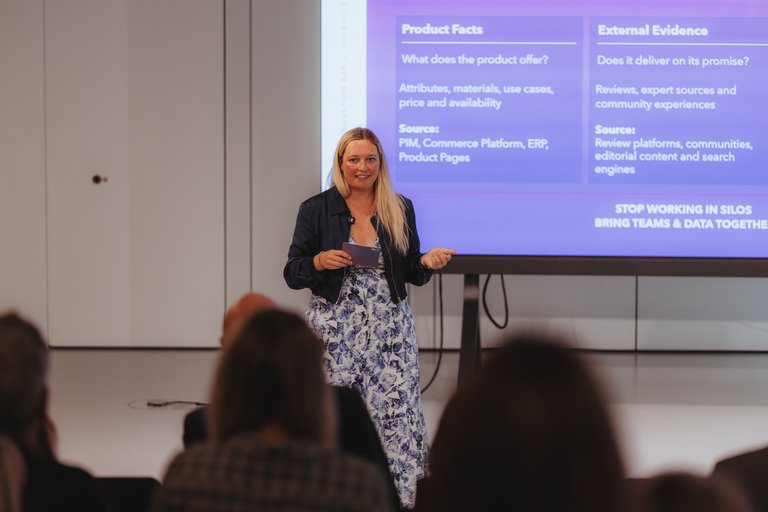
This is where the discussion shifts from Agentic Commerce to AI readiness. AI does not evaluate products the way people do. Humans often rely on habits, emotions, brand familiarity or instinct. AI relies on information. To generate recommendations, it combines product facts, external evidence and customer context. Product specifications, availability and pricing are one part of the equation. Reviews, expert opinions and online discussions provide validation. Consumer preferences, purchase history and the context of a specific request complete the picture. The result is a fundamentally different form of product discovery, one that doesn’t only depend on brand perception alone but on whether a product can be clearly understood, explained and matched to a specific need.
That is why one message appeared repeatedly throughout the session: if AI can't read it, AI won't recommend it. Product data that was originally created for internal systems or online shops is often insufficient for AI-driven discovery. Dimensions and technical attributes alone do not explain why a product exists, who it is for or in which situation it creates value. AI-driven shopping increasingly rewards brands that provide context, explain use cases and answer intention-based questions rather than simply listing specifications. In that sense, AI is creating pressure for better product storytelling, not just better technology.
Yet content alone is not enough. The speakers argued that the real prerequisite for AI Commerce is Unified Commerce—the seamless integration of channels, data and operations to create one consistent commerce experience across every customer touchpoint. Many organizations still operate in silos. Product information sits in one system, customer data in another, while marketing, commerce, service and sales teams work toward different goals. That model becomes increasingly problematic when AI systems pull information from multiple sources simultaneously. If data is inconsistent, incomplete or disconnected, brands become harder to understand. Unified Commerce therefore moves beyond an organizational buzzword. It becomes the foundation that enables AI Commerce to work at all. One connected system, one customer view and one source of truth create the conditions that allow AI to deliver meaningful recommendations in the first place.
The irony is that the industry is fixated on Agentic Commerce while many brands are still struggling with the basics. Autonomous purchasing agents may eventually negotiate directly with retailers and complete transactions with minimal human involvement. But before that future arrives, organizations need accurate product data, connected systems, cloud-ready infrastructure and a clear understanding of how AI already influences buying decisions today. If those foundations are missing, the vision of Agentic Commerce remains out of reach.
The future of commerce may well belong to agents. But the more immediate question is whether brands are ready for the intelligence layer that already sits between them and their customers. AI Commerce is no longer a future scenario. It is an emerging reality. And the brands that succeed will not necessarily be those with the most advanced AI initiatives, but those that make themselves easiest for AI to understand, compare and recommend.